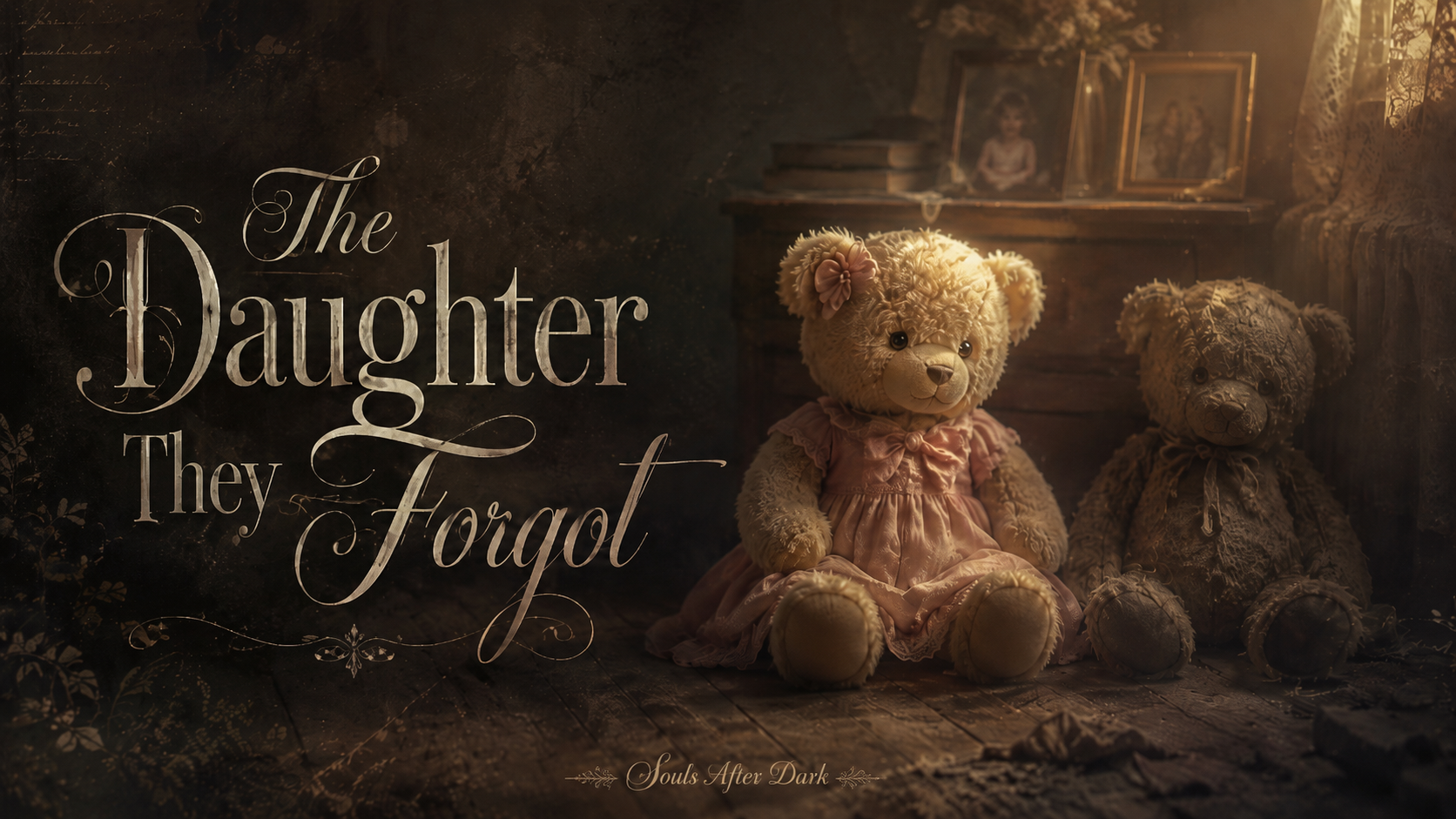
We were two daughters, two sisters, raised beneath the same roof. We slept behind the same walls, ate at the same table, listened to the same parents moving through the same rooms. We came from the same blood, the same history, the same family photographs people would later look at and mistake for evidence that we had been loved equally. From the outside, our childhoods appeared almost identical. The same home. The same rules. The same people calling themselves ours.
And somehow, we became completely different stories.
She was the daughter people noticed. She was the one they loved easily, the one they adored without needing a reason. Her name was spoken with a warmth I learned to recognize before I was old enough to understand why it hurt. When she entered a room, faces changed. Voices softened. People turned toward her as if something beautiful had arrived. She did not have to demand attention or perform for it. It simply found her.
People remembered the smallest things about her. They remembered her favorite color, the food she liked, the clothes she wanted, the songs she played too many times. They remembered what she dreamed about becoming and where she wanted to go. They noticed when she changed her hair. They noticed when she was quieter than usual. They remembered stories she had told years ago and brought them up as if every piece of her was worth keeping.
And I was there too.
That is the part I cannot forget.
I was always there.
I stood in the same rooms, close enough to hear people remembering everything about her while struggling to recall anything about me. I had favorite things too, but nobody seemed curious enough to learn them. I had dreams, but I learned to keep them small and private because nobody asked me to speak them aloud. I had feelings moving through me with nowhere to go, whole worlds forming silently inside my chest, but people rarely looked in my direction long enough to wonder what I was thinking.
I became the girl standing beside her. The quiet one. The shadow in the family photograph. The daughter people vaguely recognized but could not quite describe. I was introduced in relation to her, remembered through her, measured against her. Even when someone looked directly at me, I could feel them searching for the resemblance, trying to understand how two girls from the same family could feel so different to love.
She was beautiful. She was graceful. She was taller, softer, more charming. She knew how to belong to people. She knew how to make them laugh and how to make them want her close. She had a way of existing that did not appear to require effort. She could simply be, and people found something to adore.
I was clever.
That was mine.
It was the only thing I was good at, or at least the only thing anyone ever allowed me to believe belonged to me. I had achievements. I had grades. I had certificates, books, exams, praise from teachers and numbers written in red ink at the top of pages. I knew how to study until my eyes burned. I knew how to make myself useful through knowledge. I knew how to earn approval for a moment by bringing home another accomplishment.
She was everything else.
She was the beautiful one, the lovable one, the one people wanted around. I was the intelligent one, as though intelligence were not a part of me but a consolation prize handed to the daughter who had lost every other competition before she understood there was one.
They praised my mind because there was nothing else about me they seemed interested in praising. I became the daughter of achievements and academia, the one expected to succeed because success was the only way I knew how to make anyone look at me. I thought that if I did well enough, if I became impressive enough, if I collected enough proof that I had value, someone would finally speak my name with the same tenderness they used for hers.
So I worked.
I worked until achievement became a form of begging.
Every good grade was a hand reaching out. Every certificate was another quiet plea. Every accomplishment was me saying, Look at me. Please, just look at me. Tell me that I am special too. Tell me there is something about me worth remembering when she is not standing beside me.
For a few minutes, sometimes, it worked. My mother would tell someone what I had achieved. A relative would nod and say I had always been the smart one. A teacher would praise me. Someone would say I would go far.
Then the moment would pass.
The paper would be placed in a drawer. The achievement would become old news. The conversation would return to her beauty, her charm, her life, her dreams. People wanted to know how she was doing. They wanted to hear what she had been wearing, where she had gone, who she had met. My success could capture their attention temporarily, but she could hold it simply by existing.
I had to keep accomplishing things to remain visible.
She only had to enter the room.
The older I became, the more exhausting it was to understand that the one thing I possessed was not enough to make me lovable. Intelligence made people respect me from a distance, perhaps. It made them expect things from me. It made them assume I would be fine. But it did not make them hold me closer. It did not make them remember what frightened me or notice when I was falling apart. It did not make them choose me first.
Being clever became another reason people believed I needed less.
She was the one who needed tenderness. I was the one who would understand.
She was the one who needed reassurance. I was the one who should know better.
She was the one who could be fragile. I was the one expected to survive.
And I did survive, but not because it did not hurt.
I survived because nobody seemed interested in what would happen if I did not.
I learned how to stand without being seen. I learned to disappear into crowds I had never been invited to belong to. I learned how to clap for someone else’s happiness while my own hands felt empty. I stood in the shadows and celebrated her because none of this was her fault. I smiled when people praised her, agreed when they called her beautiful and nodded when they said she was special.
She was special.
I knew that.
The ache came from wondering why only one daughter was allowed to be.
I did not want to take anything away from her. I only wanted someone to give something to me too. I did not need her to become less beautiful so I could feel beautiful. I did not need her to be loved less. I only wanted love to stop feeling like a limited resource that had already been spent by the time it reached me.
But childhood does not teach fairness gently. It teaches through repetition. One daughter’s name is spoken with excitement. The other is mentioned afterward. One daughter’s sadness gathers people around her. The other daughter’s silence is mistaken for strength. One daughter is remembered in detail. The other becomes a vague outline in the background of everyone else’s memories.
I started competing with her long before I admitted that I was competing.
I competed for attention, for praise, for a glance that lasted a little longer. I tried to be funnier, more helpful, more accomplished. I listened carefully and remembered what everyone needed. I made myself useful. I tried being louder, then quieter. I tried being agreeable. I tried causing trouble just to see whether anger might make people notice me more than obedience did.
Nothing worked.
When I succeeded, it was expected.
When she succeeded, it was celebrated.
When I spoke, people waited for me to finish.
When she spoke, people listened.
When I was quiet, nobody noticed.
When she was quiet, everyone asked what was wrong.
I began measuring every reaction. I watched my mother’s face when my sister entered the room, then watched it when she looked at me. I learned the difference between affection and obligation before I knew how to name either of them. I heard it in the tone of her voice. I saw it in the patience she saved for one daughter and the irritation she gave the other.
My sister’s mistakes were moments.
Mine became evidence of who I was.
If she cried, she was sensitive. If I cried, I was dramatic. If she became angry, someone must have hurt her. If I became angry, I was difficult. If she needed help, people stepped forward. If I needed help, they reminded me that I was capable.
I was clever, after all.
Clever girls find their own way out.
Clever girls do not need to be held.
Clever girls should understand why everyone is tired.
Clever girls should know that their mothers love them even when that love rarely feels gentle.
So I understood everything and forgave everyone while slowly becoming someone I could no longer understand.
The constant ache followed me everywhere. It lived beneath every achievement and every smile. It sat beside me at family gatherings. It followed me into classrooms and friendships and eventually into love. It was the ache of always being present and never being chosen, of standing close enough to warmth to know exactly what I was missing.
I wondered whether anyone would ever clap for me in the way I clapped for others. Not because I had earned another certificate, not because I had done something impressive, but simply because I was alive. Because I had entered the room. Because my laughter mattered. Because someone had remembered that I liked something small and meaningless.
I wanted to be remembered without having to achieve something first.
I wanted to be loved without giving people a reason.
But every year taught me the same lesson. People liked her more. They gravitated toward her. They remembered her. Even people who had known us both would ask me about her, as though I were a doorway through which they could reach the daughter they actually wanted.
How is your sister?
What is she doing now?
Is she still as beautiful?
Tell her I said hello.
Sometimes they would remember to ask about me afterward, but by then the curiosity had already left their voices. I learned to answer briefly. I am fine. I am working. Nothing much is new. There was no point unfolding myself in front of people who had only asked out of politeness.
They were so quick to forget me.
That realization did not arrive all at once. It came through small humiliations. People forgetting my birthday but remembering hers. Relatives buying her things she loved while giving me something generic because nobody knew what I liked. Conversations in which my achievements were praised, yet no one could remember what I was studying. Friends meeting both of us and later asking whether she would be coming too.
It became clear that my absence changed very little.
People could forget to invite me, forget to answer me, forget to ask where I had gone. They could lose whole pieces of my life and never realize anything was missing. I had spent years building myself through accomplishments, believing that excellence would make me unforgettable, only to discover that people remember how someone makes them feel far more easily than they remember what someone has achieved.
She made them feel warmth.
I made them feel impressed.
Warmth is invited closer.
Impressive things are admired briefly and then placed on a shelf.
I do not blame her. That is still the hardest part. She never asked for me to disappear. She never asked our mother to compare us or people to choose her. She did not stand in front of me and demand the light. She was only a daughter receiving what the world offered her.
How could I hate her for being loved?
How could I ask her to refuse affection just because I was starving beside her?
Sometimes I wanted to hate her because hatred would have been easier than this tenderness mixed with grief. But whenever I looked at her, I saw my sister, not my enemy. I saw another girl born into a role she had not chosen. She was taught that she was the beautiful one, the lovable one, the daughter who could belong anywhere. I was taught that I was the clever one, the daughter who could endure.
We were not born into different places in the same story.
We were placed there.
One of us was taught that she deserved to be adored. The other was taught that being useful should be enough.
For years, I refused to give up. Some part of me remained convinced that if I found the right version of myself, people would finally love me the way they loved her. I kept competing silently. I became more accomplished. I made myself smaller when my presence seemed inconvenient and brighter when silence failed. I learned how to speak well, how to dress better, how to make people laugh. I watched her and tried to understand what came naturally to her that remained impossible for me.
I copied pieces of her without meaning to. The way she smiled. The way she told stories. The way she seemed unafraid of taking up space. I thought perhaps people would recognize something they loved in her and love it in me too.
But borrowed light never felt like mine.
And people could always tell the difference.
No matter what I did, she remained the one they preferred. Even when I achieved more. Even when I worked harder. Even when I stayed, helped, listened and gave until there was almost nothing left of me. Preference had nothing to do with fairness. Love did not behave like a reward for effort.
I could not outwork her beauty.
I could not out-achieve her warmth.
I could not earn the kind of affection she received without asking.
The competition got me nowhere except farther away from myself.
Every attempt to be chosen made me feel more rejected. Every effort to become like her became another way of admitting that I believed being myself would never be enough. I spent so much of my life trying to defeat an invisible opponent who had never agreed to the fight.
Eventually, I became tired.
Not the kind of tired that sleep repairs. I became tired in the deepest part of me, where hope had been working without rest for years. I could no longer keep walking into rooms and wondering how I could make myself matter. I could no longer study every face for proof that this time someone might prefer me.
So I stopped competing.
I stopped believing the next achievement would change anything. I stopped waiting for praise to turn into tenderness. I stopped imagining that one day our mother would look at us and suddenly understand what she had done.
I accepted that people would probably like her more than me.
There is no beautiful way to say that.
It did not feel like freedom at first. It felt like surrender. Like lying down inside the loneliness I had spent my whole life trying to escape. It was the death of the belief that I might someday become lovable enough to win.
But perhaps there had never been anything to win.
Perhaps love was never supposed to be a competition between sisters. Perhaps a child should never have to outperform another child for the right to feel visible. Perhaps my mother should have known that praising one daughter through the other daughter’s absence would leave a wound neither of us could fully understand.
I see my mother in myself now, especially when anger rises over something small. A forgotten message. A distracted response. Someone speaking over me. Someone praising another woman while offering me silence. A person leaving without noticing I have gone quiet.
The moment may be small, but the pain is never only about the moment.
It carries every room where I stood unseen. Every time my mother compared us. Every time I felt her disappointment settle over me before I had even done anything wrong. Every time I watched her tenderness move easily toward my sister and become something harder when it reached me.
She shaped me.
She taught me to recognize love through scarcity. She taught me that there would always be another woman who was easier to choose. She taught me to expect replacement before belonging, to prepare for abandonment before affection had even begun.
Now, when someone forgets me, I do not only feel forgotten by them.
I become the forgotten daughter again.
The girl with the certificates in her hands, waiting for someone to be proud for longer than a minute. The clever girl who could answer every question except the one that mattered most.
Why was I so easy to leave unseen?
I have spent years trying to answer it. I searched my face, my body, my voice and my personality. I studied my flaws as if somewhere among them I would discover the reason people turned toward her and away from me.
Perhaps there was no reason.
Perhaps some children are simply given roles, and everyone becomes too comfortable with the story to question it. She was the daughter to love. I was the daughter who would manage.
And I did manage.
I became independent because dependence had never felt safe. I became quiet because speaking did not guarantee I would be heard. I became angry because grief had been ignored for too long and needed a louder voice. I became lonely because loneliness was the only place where I was no longer competing.
Alone, there was no one beside me to be preferred.
No one to be compared with.
No one entering the room and making me disappear.
So loneliness became both punishment and protection. It hurt, but it did not surprise me. It did not ask me to hope. It did not make me fight for a place and then prove that place had never truly been mine.
Sometimes I think I will be lonely forever.
Not necessarily because no one will ever love me, but because some part of me will always be waiting for them to love someone else more. There will always be a distance I cannot cross, an old ache whispering that affection is temporary and preference belongs to someone prettier, softer, easier.
Perhaps I will always feel like the daughter beside her, even when she is nowhere near me.
Perhaps every room will contain an invisible sister.
Perhaps every love will feel like a competition I have already lost.
I wish this ended differently. I wish I could say I learned to love myself so completely that none of it mattered anymore. But healing does not erase childhood that neatly. Sometimes I still want to be chosen. Sometimes I still ache when people remember everyone but me. Sometimes I still become that little girl collecting achievements, wondering how many more she needs before someone keeps her in their heart.
But I am beginning to understand that I was never less worthy.
Her being loved did not mean I was unlovable.
Her beauty did not erase mine.
Her warmth did not make me cold.
Her existence did not turn me into a shadow.
The people around us did that when they decided there was only enough light for one daughter.
We were two sisters who should have been allowed to become two complete human beings. She should have been beautiful and clever and difficult and soft. I should have been clever and beautiful and complicated and loved. Neither of us should have been reduced to a single quality so the family could understand us more easily.
I was the clever one.
But I was never only clever.
I was a child who wanted someone to remember her favorite things. I was a girl who wanted her mother’s face to change when she entered the room. I was a sister who clapped from the shadows until her hands became tired. I was a daughter who kept accomplishing things because she believed success might someday feel like love.
And in the end, they still found it so easy to forget me.
Maybe that is where my loneliness began. Not in being alone, but in discovering that my presence and my absence seemed to weigh the same. In realizing that I could work, excel, achieve and remain, and people would still turn toward someone else.
So I gave up the competition.
I let her be the one people liked more.
I let them remember her.
I let them forget me.
And now I live inside the silence that followed, trying to convince myself that surrender is not the same as peace. Trying to understand whether loneliness is my fate or simply the only home I have known long enough to stop questioning.
I am still here, somewhere beneath all the things I achieved to be seen.
The daughter they forgot.
The sister beside the light.
The clever girl who finally understood that no accomplishment could make people love her in the way she had spent her whole life begging to be loved.
And perhaps that is the deepest grief of all.
Not that they chose her.
But that, after years of trying to make them choose me too, I eventually stopped believing anyone ever would.